Stage 3 of 7 in the course
Pitch
How fast the folds vibrate
Pitch is how fast your vocal folds open and close. Slower sounds lower. Faster sounds higher.
- LowerSlower
- HigherFaster
Slowed right down. Real folds do this hundreds of times a second.
There's no note you have to hit. You start from what's easy for your voice tonight.
We've left pitch until now on purpose: pushing it up on a heavy, dark voice mostly produces strain. What we work on is finding a range that's comfortable for you, and staying in it.
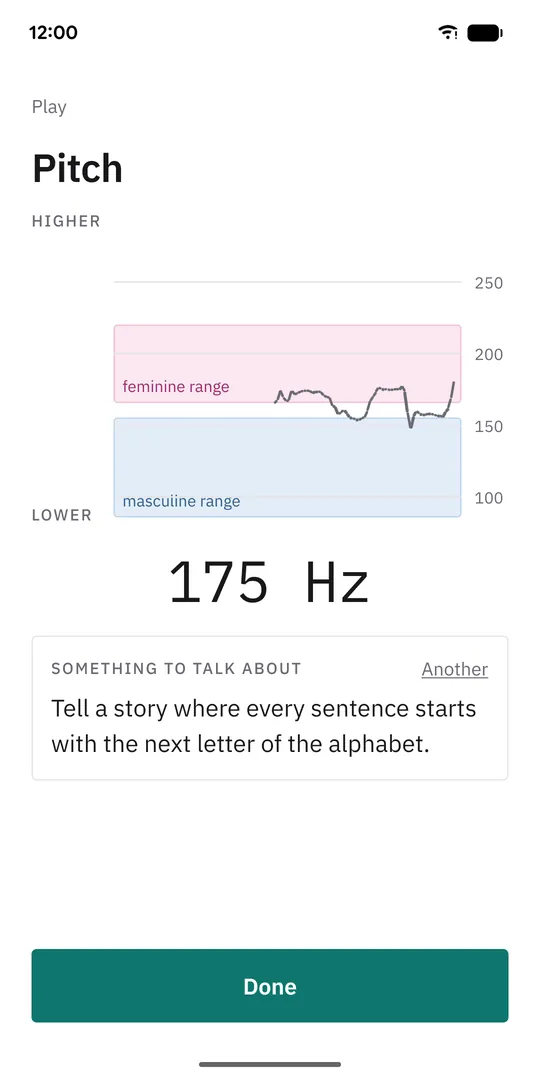
What to expect
Comfort beats height, every time. If it tightens or hurts, stop. Each session ends with a quick check for exactly that.
What changes it
Easy pitch
Start from your easy note
- Do this
- Say “mm-hmm” like you're casually agreeing. Notice the note it lands on. Then carry that note straight into “yes” or “hello”.
- You'll know it's working when
- The word starts on the same note, with no reaching for it.
In the app: Mm-hmm, then a word (P1), 1.5 min
Easy pitch
Find tonight's ceiling
- Do this
- On an easy “ng”, glide slowly up. Stop the moment the sound thins, catches or takes more effort. Then glide gently back down.
- You'll know it's working when
- You can point to where it changed, and you stopped there, not past it.
Tomorrow's ceiling will be somewhere else. That's normal.
In the app: Top of comfortable (P2), 1.5 min
Easy pitch
A range, not a note
- Do this
- Hum three or four different easy notes, here and there, not in order. After each one, ask only: was that easy?
- You'll know it's working when
- You can find a few different notes that all felt easy.
In the app: A comfortable range (P4), 1.5 min
Putting it together: easy, not pushed
A question lifts your pitch for you, with no reaching.
- Start from your easy note
- Stay under tonight's ceiling
- Let questions and brightness lift it
Pitch often rises on its own as your resonance gets brighter. You don't need to force it.
After each exercise, check your throat. If it feels tight or worked, stop for today.
Good to know
It isn't the main thing
In the research, pitch is the strongest single predictor of whether a listener hears a voice as male or female. But one large review found it accounts for around 42% of the variation in how voices get gendered. It's the biggest single factor, and still less than half of what's going on.
In one 2025 study, trans women averaging 146 Hz were still mostly heard as feminine. That's below the target most apps give you. Voices well below the “female range” get heard as female all the time, because the rest of the voice is doing the work.
Why it comes after resonance and weight
Pushing your pitch up while your voice is still heavy is a lot of effort for not much. It usually comes out strained and thin, because you're fighting your voice rather than adjusting it.
It's also risky. Chasing a pitch target is the most common way people hurt themselves practising alone, and that's well documented. Reaching for a number that doesn't suit your voice causes tension, and tension leads to hoarseness, or worse.
This is practice, not medical care. Keep it comfortable: if your throat feels tight, sore or tired, stop for today. Read Looking after your voice, and see a speech and language therapist if hoarseness lasts more than a few days.